My father, John “Jack” Sours, served as a LRRP (long-range reconnaissance patrol) in Vietnam from 1968 to 1969, and the war stayed with him for the rest of his life. In his final years, he poured that history into more than 60 paintings—spanning his experience, the Vietnamese experience, and the American experience of the war.
-
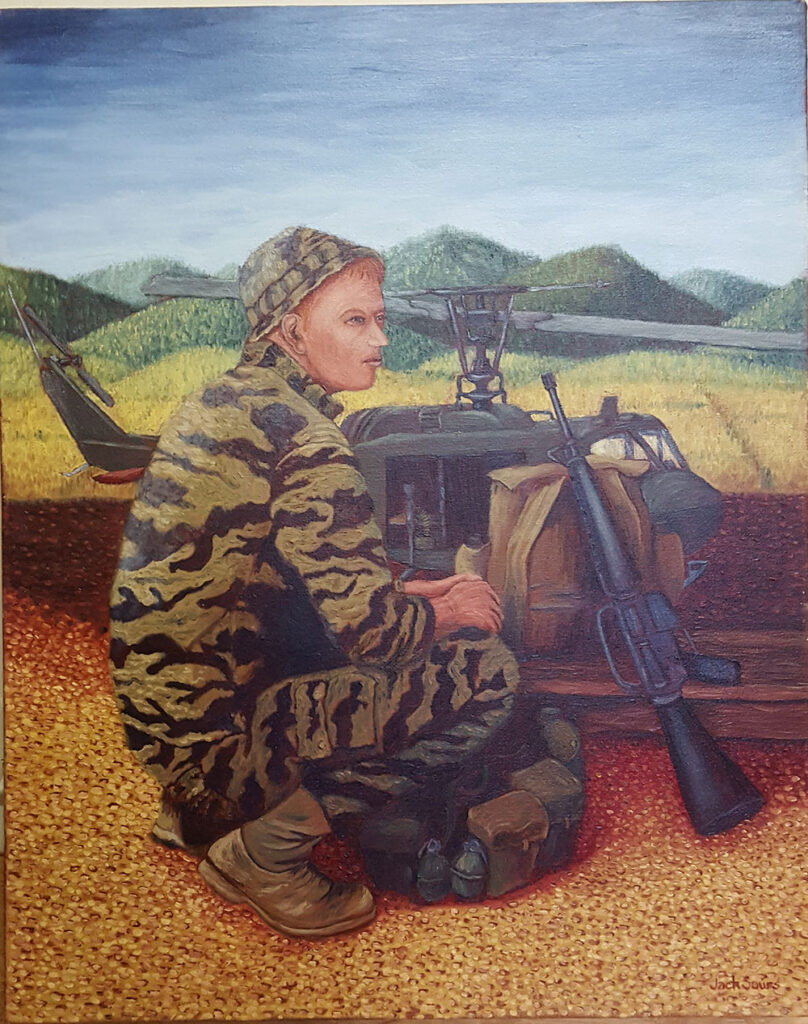
#39 “Sgt. John A. Sours, Reluctant Warrior” (9/18/14 – 10/1/14)
“I abandoned ‘The Lo’ so that I would have an image that is mine alone. ‘It is not possible for this child to accomodate the thought that action is immoral and then continue to act.’” — Jack Sours’ artist note (View larger)
I’m grateful to Richard Meers, a Vietnam veteran who served from 1966 to 1967, for keeping the full collection on display at the Fort Smith barracks from 2022 to 2025. Though he never knew my dad, he felt a deep connection with him and honored it.
Those who served often live with memories that never fully settle. Before he began the series 2013, Dad was belatedly diagnosed with PTSD and became increasingly angry. His stubbornness and self-discipline sustained him, though, and painting gave him a place to put some of that anger. As he finalized the series and shifted his focus, he softened slightly and began to accept his circumstance.
“PTSD is a thing that sneaks up on you, and you can ignore it and you can say no it’s not happening and you can bear down and get an education and do all that stuff but it’s there and it just keeps getting worse…” — Jack Sours Interview 11/20/2018
He found a kind of purpose by digging into the politics and photography of the war. A couple of years after the collection was completed, we recorded the interview below. In it, he acknowledges the controversial and sometimes propagandistic nature of his subject matter, but stands by his premise that the war was wrong. In another year, he was diagnosed with cancer. Knowing it would trigger his PTSD, he refused treatment and died six months later.
He left behind discipline, conflict, and a body of work that refuses to look away. I share it here to help keep his story, the story of the Vietnam War, alive.
— Suzie Sours Israel, April 2026
Jack Sours Interview 11/20/2018
Tell me about your favorite parts of the series.
The deal was that anyone who didn’t do exactly what the French said, you know, not complain when they raped their wives, you know, that stuff, then this was their fate, so and then they were hanged after this.
-
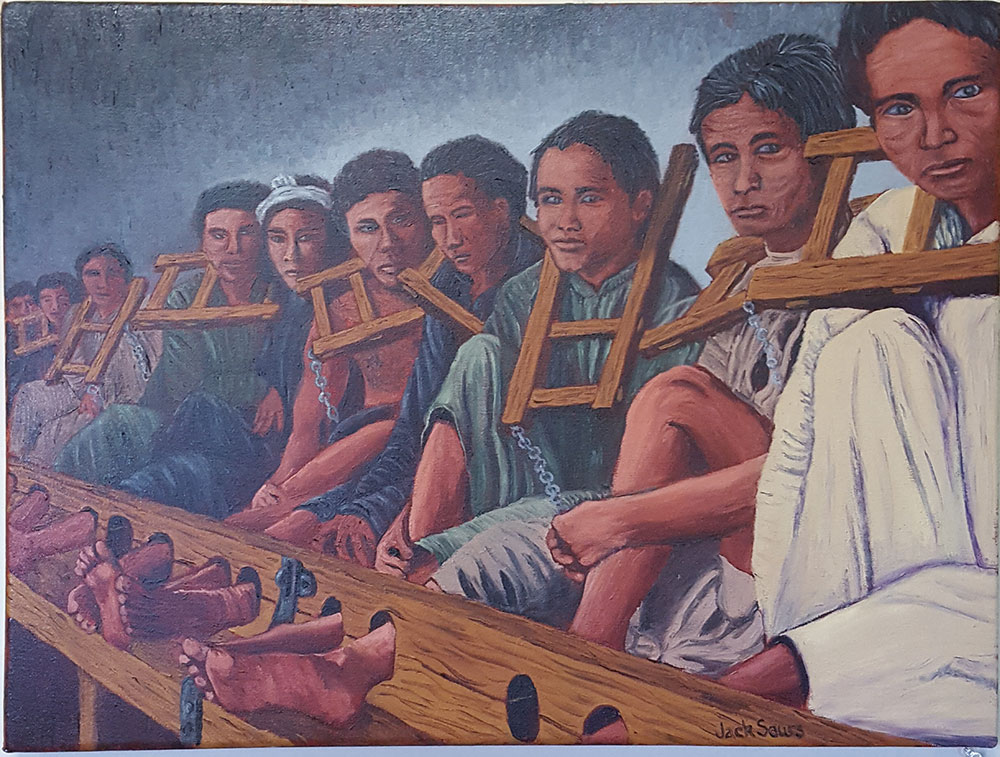
#11 “Vietnamese Nationals 1907” (begun 12/25/13, finished 1/5/14)
“Maybe my favorite painting, at least in the top 5. Ho Chi Minh would have witnessed this event or something like it setting the course of his life’s work.” — Jack Sours’ artist note (View larger)
So Ho Chi Minh would have seen all that, and that’s when he made his decisions. He was a child basically, I think he was only 15 years old or something like that…made his way to Europe, educated himself in France, became enamoured with the Communist Party in France in the early part of the century and then he started working his way back into Vietnam through China and then established a foothold in a mountain hideaway and he began working against the French then. WWII came along and Ho Chi Minh was our strongest ally in SE Asia. He provided us intelligence, he was all about building a relationship with the United States. So after the war the French insisted on keeping it as a colony and the US [capitulated] to them, but Ho Chi Minh was pleading with us to help him, so had we gone in to help him, that would have all been avoided. So then as it happened the French tried to clamp down on them again and they defeated them at (dim in ku) Ho Chi Minh was bound and determined to have a united Vietnam and contrary to what they said in the South it was a brutal regime the den Diem [regime]—he was a brutal [man] and the government was just as corrupt as it could be and…we were giving them these things and they were selling them. That happens…anytime you have a colony you can choose some of the local people to be the enforcers or the magistrates or things like that so you can say look what I’m doing but they only stayed in place if they did exactly what the French told them to do and so that was the way that power base was built.
-
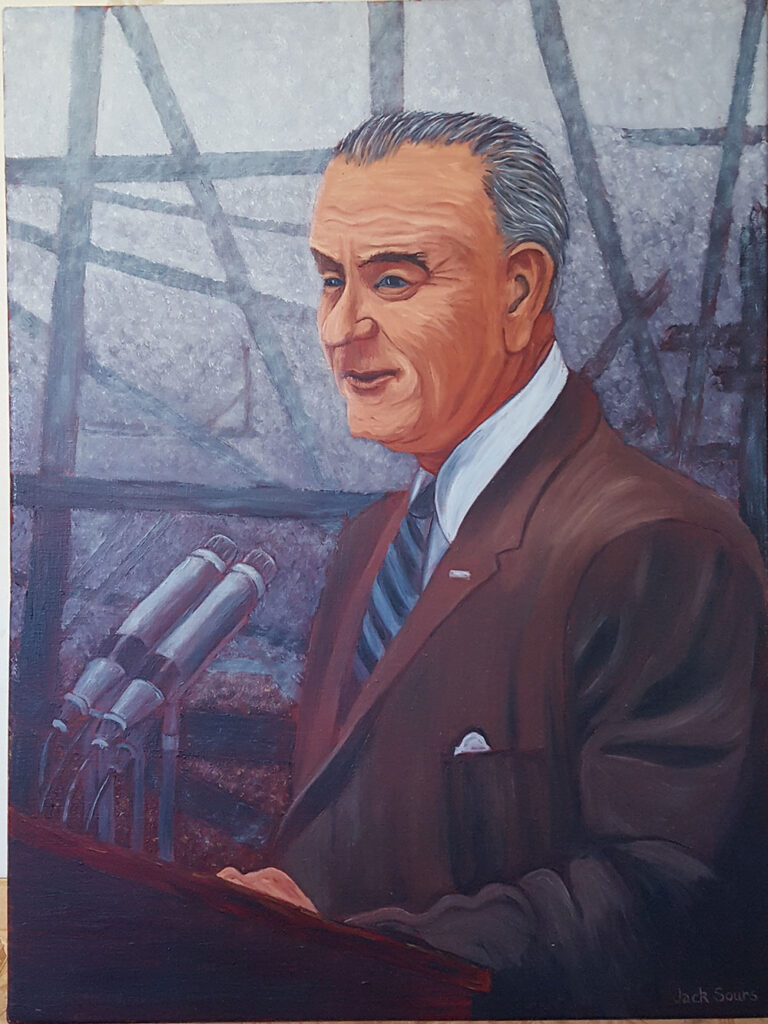
#53 “Why Vietnam” (2/7/16 – 2/14/16)
President Johnson stated, “We do not want an expanding struggle with consequences, that no one can perceive, nor will we bluster or bully or flaunt our power, but we will not surrender and we will not retreat, for behind our American pledge lies the determination and resources, I believe, of all of the American nation.” — News Conference (28 July 1965) (View larger)
-
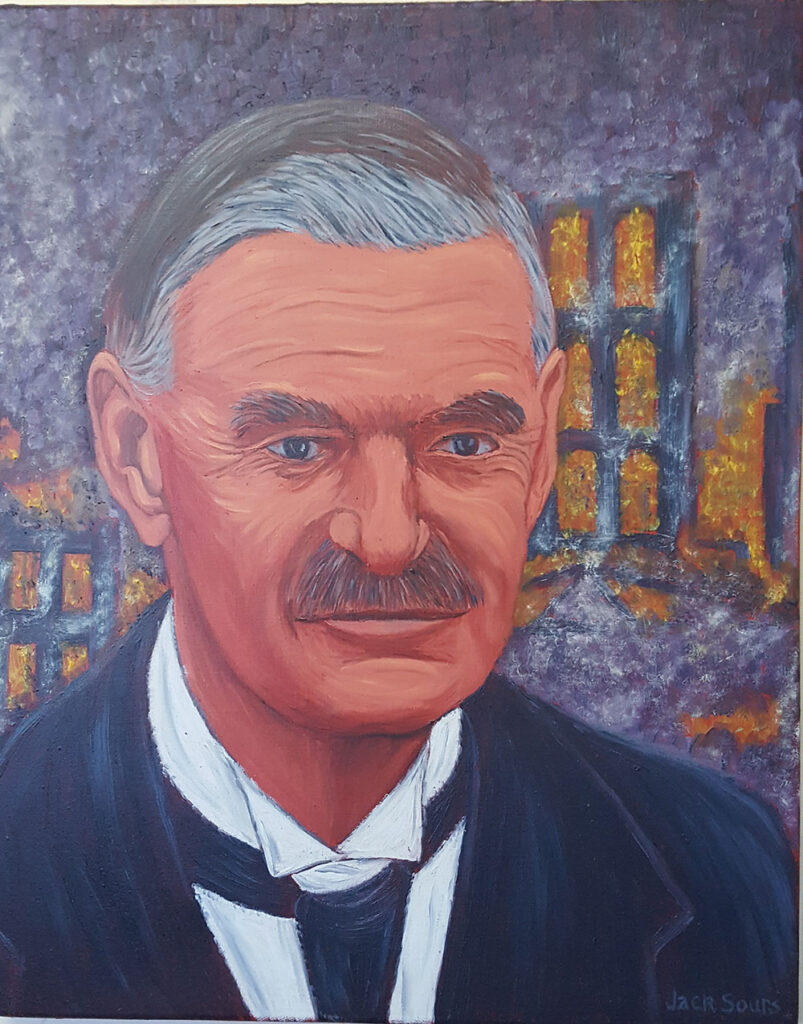
#56 “Nevill Chamberlin” (2/16?)
“Appeasement ‘Nevill Chamberlin‘ a propoganda image to point out what happened when he did not confront Hitler” — Jack Sours’ artist note (View larger)
-
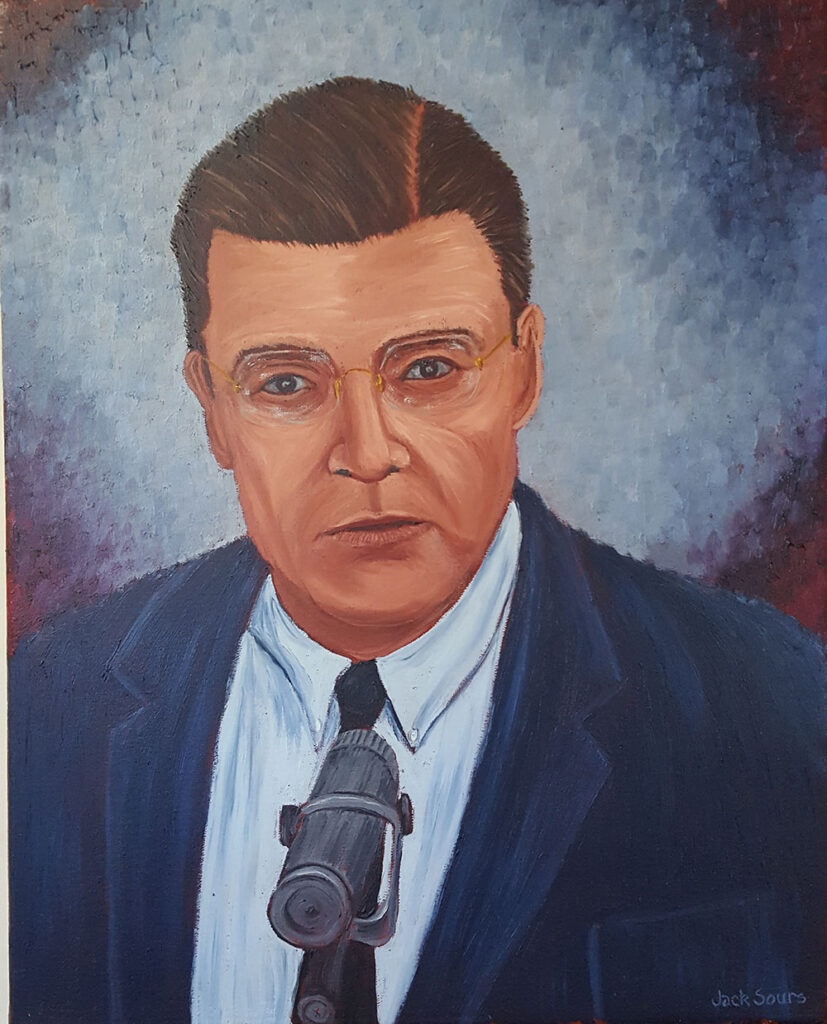
#58 “McNamara” (3/6/16 – 3/13/16)
“The Macavallian Dr. McNamara” — Jack Sours’ artist note (View larger)
Then we go to Johnson of course…while I’m not particularly fond of the Macnamara painting, he was a horrible person. I mean it was all about body count to him, and statistics. That was Chamberlain and the reason I wanted him was he was always the big scapegoat, the reason we don’t try to talk to anybody. He was trying to [talk to Hitler and negotiate a peace] and then Hitler pulled the wool over his eyes…This is the threat of the communist hordes. This is always the spectre that’s brought up, this was what was brought up by Bush before he went to [Iraq]…[he said] “I remember…A long time ago there was another person who we thought we could stop and we didn’t”…people said it everywhere, it was like a talking point, it worked its way into our lexicon. And this was Ho Chi Minh…and now we’re into the…these are nice because now they’re big. I think this is very instructive of what was going on in the nation…and that’s back in the states…that’s when my demons drove me into the mountains.
Why were you compelled to do the series?
I think for me it was a matter of bearing guilt for what I was because when I was in Vietnam, I was…you know we were…we were volunteers and we were probably as…patriotism and mission was important, and they were the gooks, and they were less than human, but then things happened along the way to make me realize that hey, that’s not right. This isn’t right, what we’re doing here, you know the idea of body count Mei Lai, and Mei Lai…it was one of the worst but it was not an isolated incident and uh what we were…that only became clear later after I was back in the United States. Even after I was married and you guys were there and… uh, a lot of things started to fall apart in my life.
PTSD is a thing that sneaks up on you, and you can ignore it and you can say no it’s not happening and you can bear down and get an education and do all that stuff but it’s there and it just keeps getting worse and then…when i…went out in the cold basically when I went out and was homeless…it all comes to bear.
-
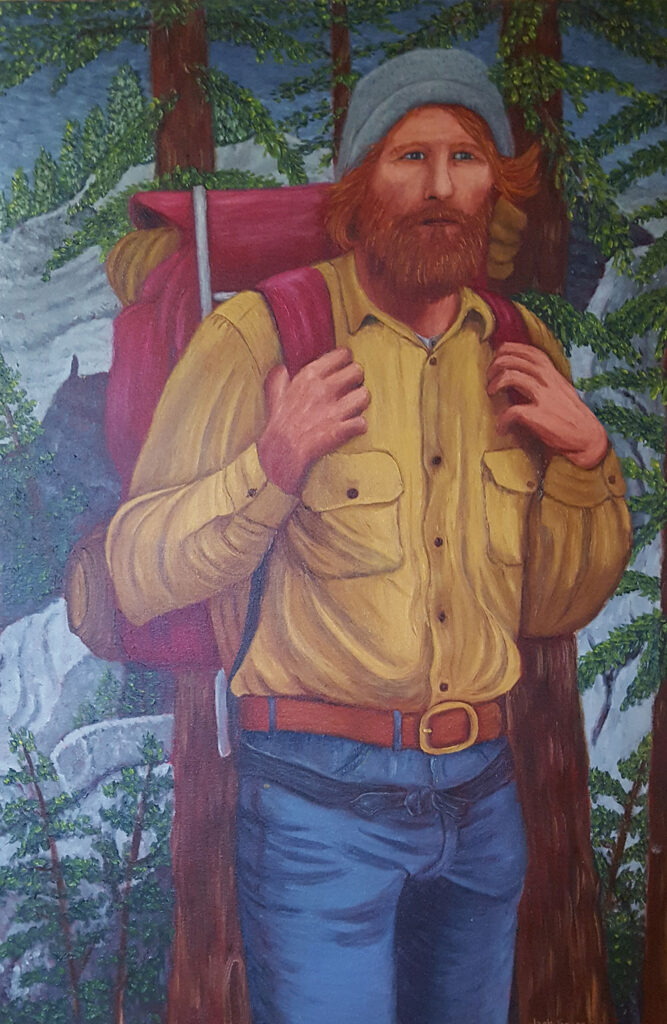
#40 “5 Years Homeless” (10/24/18 – 11/3/18)
“In my 5th year of homelessness. A very difficult painting of very difficult times. My demons have chased me into the Cascade Mts alone and tortured.” — Jack Sours’ artist note (View larger)
And then the event that brought me back was Dad’s death I think because it happened right in front of me and that’s when I thought…I’ve got to get back with you and Dan and establish what I could there. And then I tried to be a normal person for a long time again and…I worked hard. I mean, we ran the farm and we did all that and I just didn’t allow for any of that thinking so much, and when I started painting I tried to find things that were important to me.
So Vietnam was pressing on me again and so I just started painting it. And like in the beginning I had no idea where I was going or where I would get my image and all that, and anytime you start a thing then this comes and that comes and this comes and so I would go to bookstores in Lawrence and Fayetteville and wherever I could and look and see what I could find..and then, uh, a lot of it came before I found Another Vietnam but Another Vietnam (Another Vietnam: Pictures of the War from the Other Side by Tim Page) was a perspective from the North, a perspective from a different place. Ho Chi Minh had like 3500 photographers in the field, he was hell bent on public relations and exposing and showing and propaganda and whatever he could come up with to garner support for his cause so there were a lot of photographs from there and I don’t know (unintelligible) 2002…so this was way after the war when it was becoming more and more acceptable to criticize what happened there. And then the more I got to painting the more affinity I had for the Vietnamese people and their cause.
-
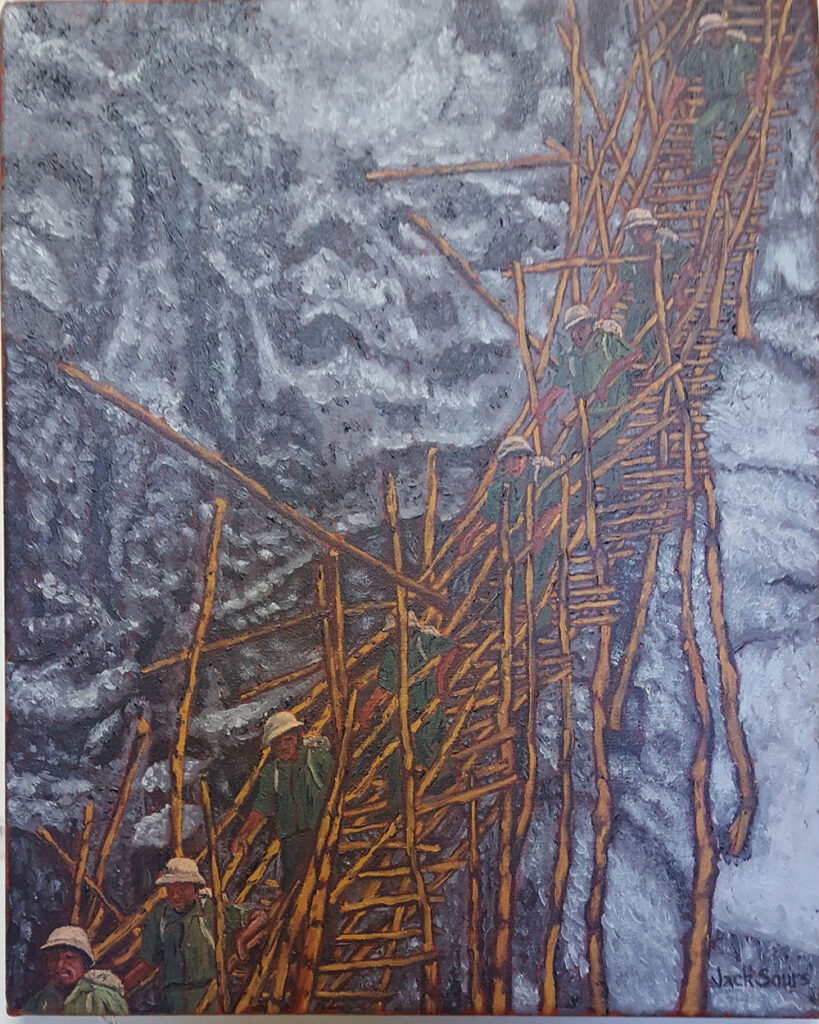
#8 “Ho Chi Minh Trail” (12/12/13)
“To depict the rudimentary engineering that nation reverted to in the transportation of men and equipment while we had helicopters air and water transports.” —Jack Sours’ artists note (View larger)
-
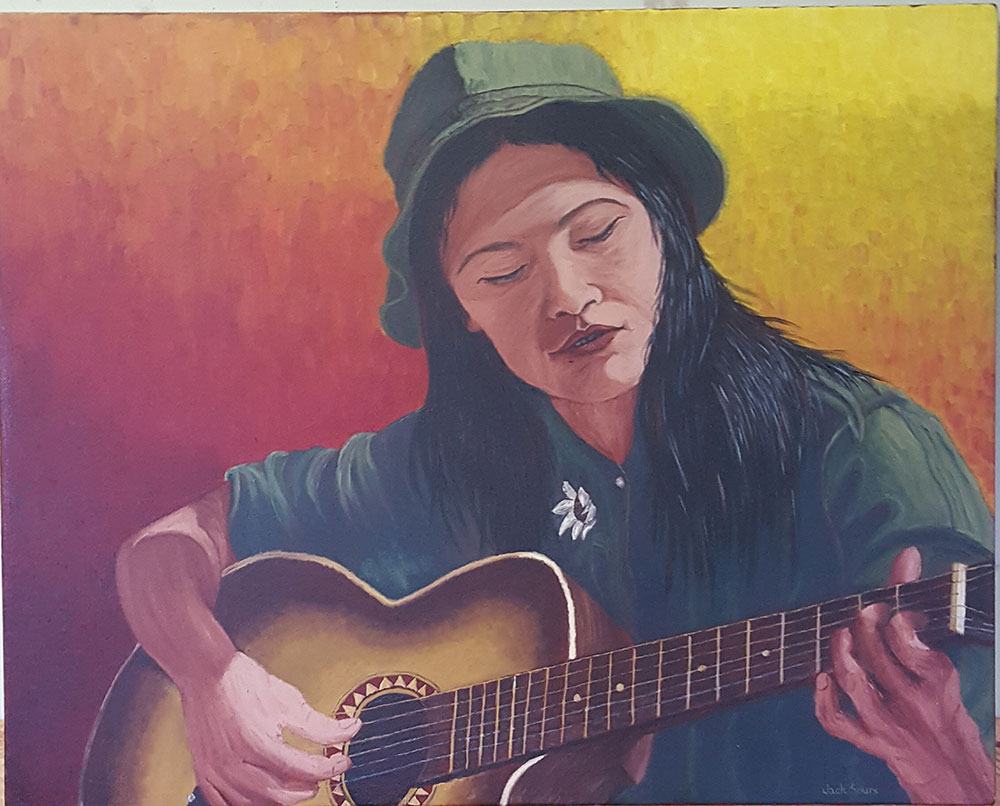
#31 “Youth Volunteer” (6/2/14)
“Tasked to diffuse time delay bombs in North Vietnam dropped by USA – blown the day after picture was taken” —Jack Sours’ artists note (View larger)
-
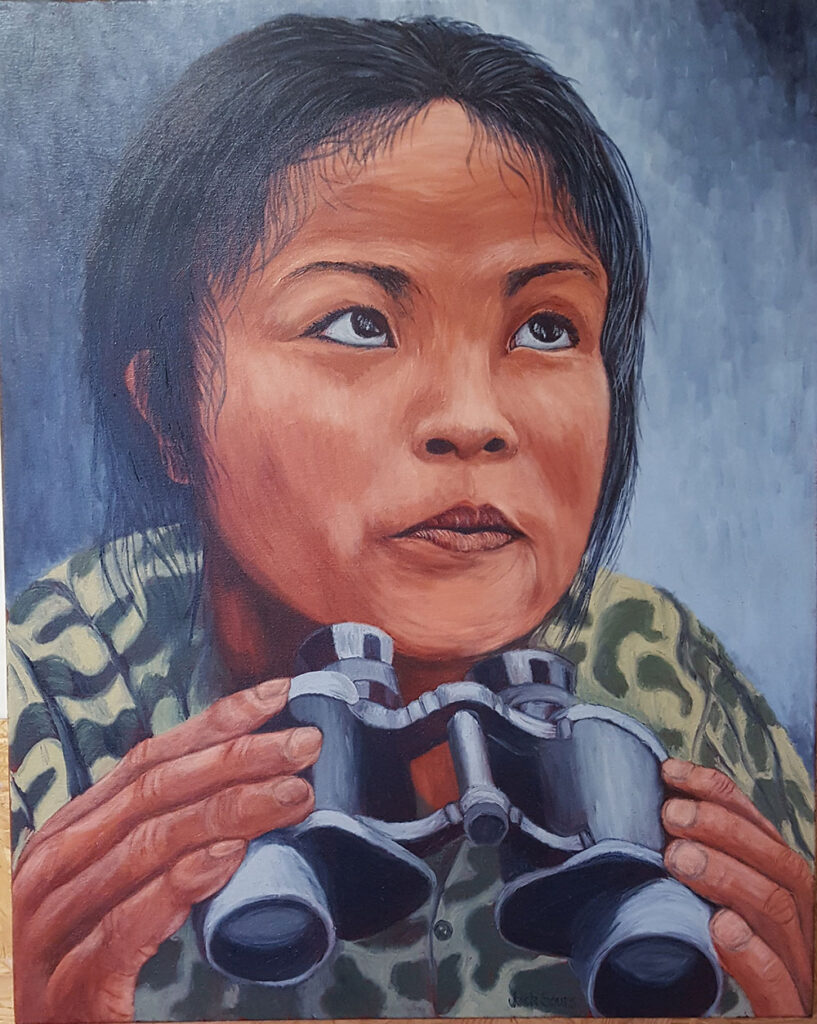
#36 “Youth Volunteer, bomb counter” (8/14-14 – 8/20/14)
“I am compelled to paint her with little reason except being compelled.” —Jack Sours’ artist note (View larger)
I mean, look at this…this is a young talented beautiful woman…she’s diffusing bombs you know. It’s pretty pitiful, tear-jerking really. She was a youth volunteer and she was a bomb diffuser, that was her job. And the day after this painting, she was blown…blown to smithereens. And there more too, some of these more…there’s one particularly of children being pulled out of the [bomb shelter?]. I was always impressed with the rudimentary nature, this is one…I mean look at that [picture of the Ho Chi Minh trail] that’s how they got places. We had helicopters, and yet they beat us. You know I mean that’s just in itself astounding. This is where that one came from. Again a youth volunteer, counting bombs so they know how many they have to diffuse. Somebody counting bombs and somebody counting how many exploded, give them an idea of what was going on. This is where that one came from. The bombing campaign against Hanoi was horrendous. I mean my god, they weren’t just bombing specific military targets they were bombing everything and everybody. They all did it out of love for Ho Chi Minh. And in the South it was like “you do it or we kill you and put you in a concentration camp and make you work like slaves.”
[Pauses for a conversation about the legality of using photographs as source material for paintings]
-
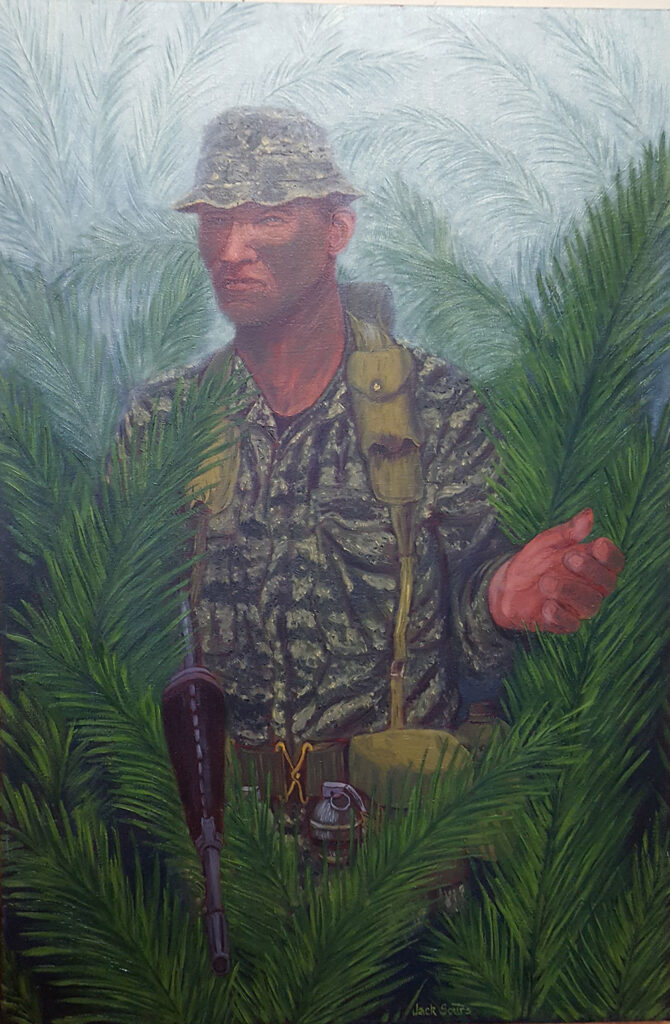
#35 “Point Man” (7/24/14 – 8/12/14)
“Point Man – faced with kill or be killed at every moment of a mission“ —Jack Sours’ artist note (View larger)
-
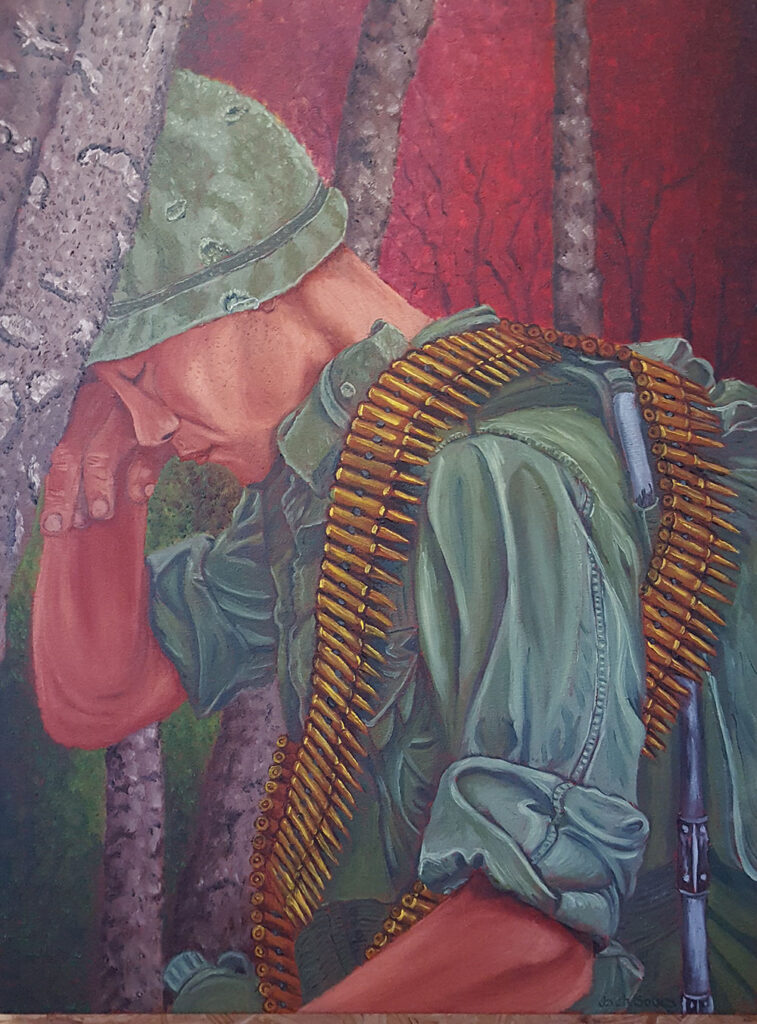
#49 “Sorrowing Warrior” (12/3/15 – 12/13/15)
“Attempting to express the sorrow of engaging in something like Vietnam.” —Jack Sours’ artist note (View larger)
-
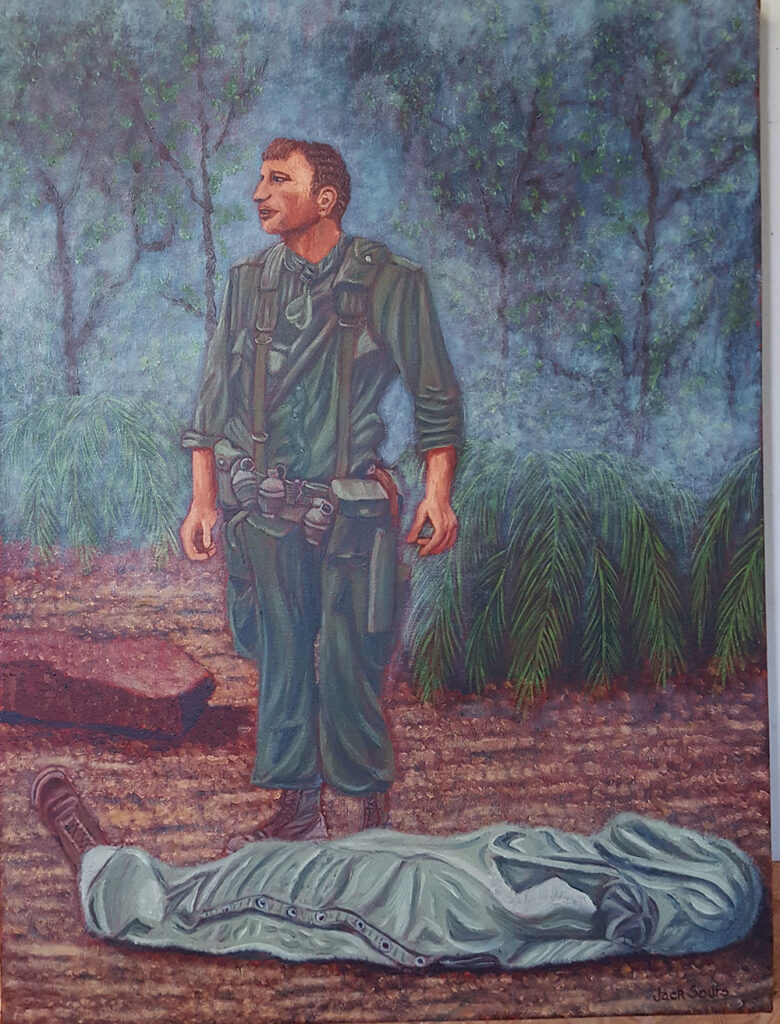
#50 “After Battle” (12/17/15 – 12/30/15)
“The sadness of transporting bodies — those who were killed. The loss of a loved one and the horror of policing up after a battle.” —Jack Sours’ artist note (View larger)
That was a concern of mine all the way through…that I was using image that were…some of them were from an American book…there was an American that purchased photographs from soldiers and photographers and published them as his own…and so he might have a [legal issue] but then I wanted the authenticity…because there’s so much disbelief, there’s so much disbelief about what went on, Oh, surely we didn’t do that, we’re not that kind of people, but we are that kind of people. That’s all part of it too. And I think that’s why Vietnam impacted our lives in such a way…there was no member of my company that came out of it normal…some of them were way too far to the right, defending to the death what we did and the honor and dignity of what we did, and some of us realized that maybe the other side had the honor and dignity. If you remember from the Burns series (The Vietnam War, a Film by Ken Burns and Lynn Novick), ’68 was a horrible year, that was, oh everybody was killing everybody, nobody knew who was who, you just saw somebody with a gun you shot them. And uh, and were anxious to do that, that was the horrible part of it. The whole idea of body count, body count, body count, let’s get some bodies, whether they were children or women or anything…and lie about it if you want to. But the immorality of the whole thing is just astounding if you look at it, if you really look at what went on over there, what was happening. I mean why would we go in to defend Dem Diem and then we install Theiu after that who was no better. Burns and Novick covered it so well it’s like they documented things that I had no idea…the idea that the corruption was so horrid, you know even Theiu himself was trying to stash money somewhere because he knew it was going to fail. Everyone knew South Vietnam was going to fail. No way it could stand…they were just…
I was struck by how the sons of the people in power never went to war…
John Kerry did, John McCain did. You can get pretty good political power by being a general, or being what John McCain was and what John Kerry was. John McCain’s dad was an Admiral. Kerry didn’t come from nothing. Very few of them do. Only if they’re brilliant and they’re able to navigate the class structure, which we have…John Kerry was admirable about it in my mind…actually McCain was pretty good too…although McCain used his power in many ways…he divorced his wife so he could marry to money and used his political power…that uh…Keting 5, big savings and loan scandal, he made big money on that. He was implicated in it, somehow bought his way out of it and, you know…John Kerry never had that problem, he never needed to do that, and he was the one denigrated way more than McCain. What they did to him in the election was…there were people who were Veterans [who] said he was lying about what he did, what he laid claim to. But that’s nothing new in American politics.
The fact that so many gulf war vets are coming back with the same kind of these symptoms leads me to believe that what they’re doing over there is not a moral thing.
This is still a big deal to me, it has been all my life, since Vietnam, the angst resulting from my experience there. My experience in Vietnam shaped my life. I want to engage in something every day or I want to be able to come out here and putter with a painting or maybe some leather work or whatever it is that I want to do, I want to start something that requires me to be on task. That quote from Johnson…everything he said was not what we did.
One of the problems I have with painting is finding the images…this series, the Vietnam series, I was passionate about it for 2 years. Even talking about this thing brings a lot of it back. It’s always there and mostly I don’t write about it, talk about it, because I think people get tired of hearing about it.